A Naming Sketchbook for a New Community Project
A naming sketchbook for a new community project helps your group compare ideas, capture the project's purpose, and choose a name that fits its identity.
The common mistake with a new community project name is choosing one before the group agrees on what the project is for. The result can be a polished name that points toward the wrong purpose, audience, or future plans. A naming sketchbook for a new community project keeps the decision tied to the work the group actually intends to do.
Use plain paper, a pen, and one candidate name at a time. Instead of treating the page as a test of whether a name sounds clever, use it to record what the project needs its name to express and where the group still has questions.
Write the project's purpose before naming it
Start with a sentence that describes the project’s intended work and the people it hopes to serve. Keep the sentence plain: “We share basic pantry supplies with neighbors” is more useful for this exercise than a slogan that could describe almost anything.
Then list the qualities the name should suggest. A neighborhood tool library might want to signal shared resources and local involvement, while a youth arts program might want to foreground making and learning. These are choices about identity, not universal rules for naming.
Keep the purpose sentence beside every candidate. If a name suggests a different activity or audience, note the mismatch rather than explaining it away.
Build candidate names from the project's own language
Collect words from the work itself: the place where it happens, the materials people use, the action they take, or the feeling the group hopes to create. Put these words on the page before combining them, so the first idea does not quietly become the only idea.
Try more than one kind of construction. A name can describe an activity, point to a place, or express a shared value. Avoid borrowing a word simply because it sounds impressive; ask whether the group can explain its connection to the project in ordinary language.
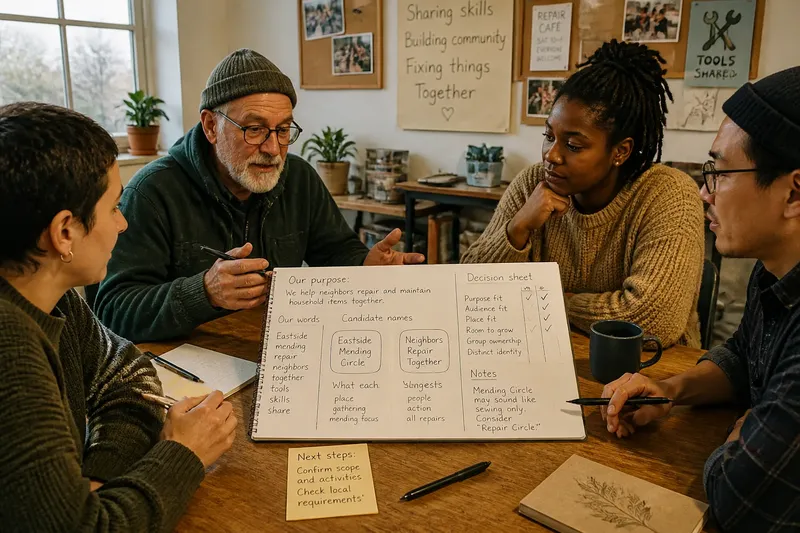
Say you are naming an imagined neighborhood repair group, and your starting words are “Eastside,” “mending,” and “neighbors.” You write “Eastside Mending Circle” and “Neighbors Repair Together” beside the purpose sentence. The first emphasizes place and gathering; the second foregrounds who acts and what they do. The group can now discuss that difference rather than debating two names without a shared frame.
Use a decision sheet to compare candidates
Give each candidate its own small space on the page. Record the purpose sentence, the identity the name seems to suggest, and the group's next decision based on what it notices.
- Purpose fit: Check whether the name points toward the work in the purpose sentence. If it suggests a different activity, revise the wording; otherwise, keep it in consideration.
- Audience fit: Check whether the intended participants can see themselves in the name. If it sounds aimed at a different group, ask whether the audience description or the name needs revision.
- Place fit: Check whether a place name accurately reflects where the project operates. If it could exclude nearby participants or imply a broader area than intended, remove or clarify the place reference.
- Room to grow: Check whether the name still fits if the project adds a related activity. If it would become misleading, choose a broader phrase or accept that a future name change may be needed.
- Group ownership: Check whether organizers can explain why the name belongs to this project. If the explanation depends on private context, revise it into language a new volunteer can understand or consider another candidate.
- Distinct identity: Check whether the name is easily confused with a group the organizers already know. If it seems too close, make a more distinctive candidate and seek appropriate local or professional advice before formal adoption.
For the imagined repair group, suppose the organizers mark “Eastside Mending Circle” as a strong fit for local gatherings but note that it sounds focused only on sewing. They could keep it if sewing is the project’s intended focus, or revise it to “Eastside Repair Circle” if the purpose also includes fixing household items. The decision follows from the stated work, not from an unsupported claim about which name people will prefer.
Decide which name best carries the group's identity
Compare candidates using the same purpose sentence and decision sheet. Write down the specific point behind each reaction: “this sounds like a class” or “this includes the whole neighborhood” is more useful than “I just like it.” A preference still matters, but it should not be mistaken for a shared understanding of the project.
When views differ, ask what each person thinks the project does after reading the name. If answers reveal different assumptions, the group has found a naming problem—or a purpose question it needs to settle before choosing.
What should the group settle before choosing a name?
Should the name describe the activity or express a value?
An activity-based name can make the project’s work apparent, while a value-based name can express the spirit organizers want to convey. Choose based on the purpose sentence, and add a plain-language description where the name alone leaves the work unclear.
Can the project use a place name?
A place reference can give a project a local identity, but organizers should consider whether its boundaries match the people and area the project intends to serve. If the fit is uncertain, leave the place name off the candidate list until the group agrees on its intended scope.
What if the project's plans may change?
Compare the candidate with the activities the group has actually discussed, not every imagined future possibility. If a name would become misleading under a likely change the organizers already plan, choose wording with more room or revisit the project description.
When should organizers check formal naming requirements?
Before using a name for registration, contracts, public claims, or other matters tied to local rules or organizational status, check the relevant official instructions. Consult a qualified professional when the consequences or requirements are unclear.
Record the choice and the reason for it
On the final page, copy the chosen name exactly as the group intends to use it and add the purpose sentence that informed the decision. Note any unresolved question, such as whether the name still fits a planned activity, so future organizers can see the tradeoff instead of reopening the whole discussion.
A naming sketchbook for a new community project is most useful as a record of why a name fits—not as a collection of attractive phrases. Keep the decision sheet with the project’s planning notes, and the next volunteer can understand the identity the group meant to carry forward.